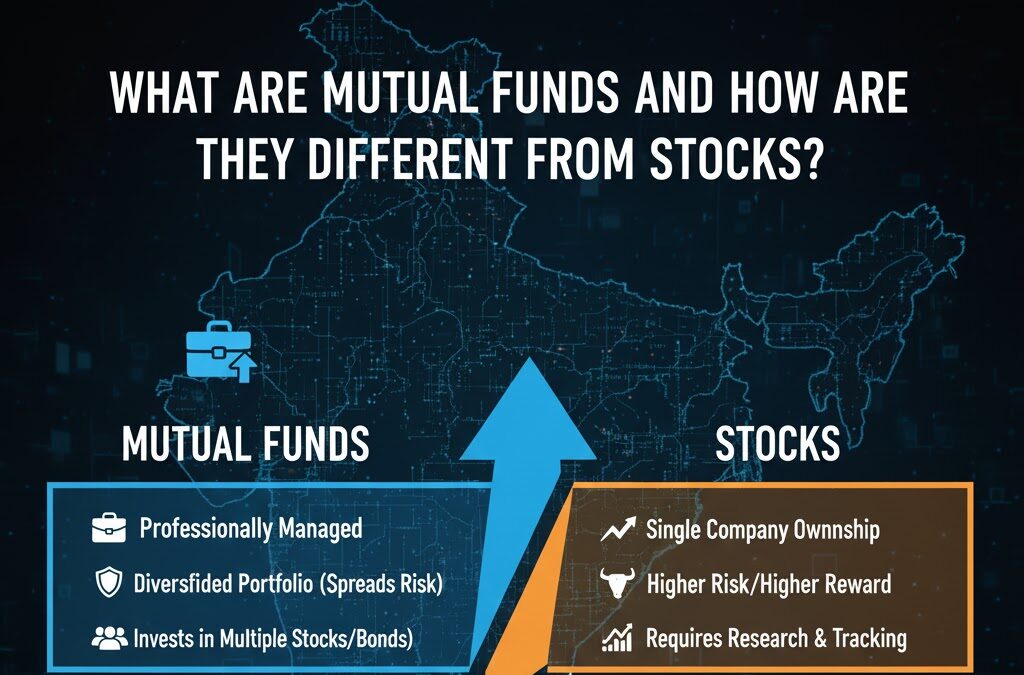
When you start your investment journey, the two most common words you’ll hear are “Stocks” and “Mutual Funds.” For many beginners, they seem similar, but they are fundamentally different tools for building wealth.
Understanding this difference is the key to deciding which one is right for you.
Let’s use a simple analogy:
- Buying a Stock is like buying a single fruit (e.g., an apple). You own that one apple directly. If it’s a great apple, you win. If it’s rotten, you lose 100%.
- Buying a Mutual Fund is like buying a fruit basket. A professional (the Fund Manager) has already selected a variety of fruits (apples, bananas, oranges, etc.) for you.1 If one apple is bad, it has very little effect on the whole basket.
🧺 What is a Mutual Fund?
A Mutual Fund is a company that pools money from many investors (like you and me) and uses that collective money to buy a large, diversified portfolio of stocks, bonds, or other assets.2
Think of it as a “collective investment.”
When you “invest in a mutual fund,” you are not buying a stock. You are buying “units” of the fund. The value of your “unit” (called the NAV – Net Asset Value) goes up or down based on the combined performance of all the investments inside that fund.3
Key Features:
- Professional Management: Each fund is managed by a “Fund Manager,” a financial expert whose full-time job is to research and decide which stocks or bonds to buy and sell for the fund.4
- Instant Diversification: When you invest even ₹1,000 into one mutual fund, your money is instantly spread across 50, 100, or even more stocks.5 This diversification is the biggest advantage, as it significantly reduces your risk.
- Types of Funds: There are hundreds of types, such as:
- Equity Funds: Invest mostly in stocks (e.g., “Nifty 50 Index Fund,” which invests in India’s top 50 companies).6
- Debt Funds: Invest in safer, interest-paying assets like bonds (like a fixed deposit, but for the market).
- Hybrid Funds: A mix of both stocks and bonds.7
🏢 What is a Stock?
A Stock (also called a “share” or “equity”) represents direct ownership in a single company.8
When you buy a share of “Tata Motors,” you become a part-owner of Tata Motors. You have a direct claim on its assets and profits.
Key Features:
- Direct Ownership: You own a piece of one specific company.
- Full Control (DIY): You are the manager. You must do your own research to decide what to buy, when to buy, and when to sell.
- Concentrated Risk: Your entire investment’s success is tied to that one company. If the company does exceptionally well, your profits can be enormous (a “multibagger”). If that one company fails, you can lose all your money.
🆚 Key Differences: Stocks vs. Mutual Funds
| Feature | Stocks (Direct Equity) | Mutual Funds |
| What You Own | A direct share of a single company (e.g., 10 shares of Reliance). | “Units” of a fund that owns a basket of many companies (e.g., 50 units of a Nifty 50 fund). |
| Who Manages It? | You. (Do-It-Yourself). You must do all the research and tracking. | A Professional Fund Manager and their research team. |
| Risk | High. Your risk is concentrated on one company. High risk, high potential reward. | Lower. Your risk is spread out (diversified). If one stock in the fund fails, 10 others may do well. |
| Cost | Brokerage. A small fee (e.g., ₹0 or ₹20) you pay to your broker for each “buy” or “sell” trade. | Expense Ratio. A small annual fee (e.g., 0.5% to 2%) paid to the fund company to cover the fund manager’s salary and operating costs. |
| Minimum Investment | The price of 1 share (can be from ₹1 to ₹100,000). | You can start with a SIP (Systematic Investment Plan) for as low as ₹100 or ₹500 per month. |
| Analogy | Buying ingredients. You must pick every vegetable, spice, and protein yourself. | Ordering a “Thali” or Buffet. The chef (fund manager) has prepared a balanced meal for you. |
✅ Who Should Choose What?
You should consider Stocks if:
- You enjoy research and want to analyze companies, read annual reports, and track the news.
- You want full control over your investments.
- You understand the high risks and are aiming for potentially higher, concentrated rewards.
- You have the time to actively monitor your portfolio.
You should consider Mutual Funds if:
- You are a beginner and want a simple, safer start.
- You don’t have time (or interest) to research individual companies.
- You want professional management of your money.
- Your main goal is diversification and long-term, steady wealth creation (e.g., through an SIP).
Conclusion
Neither stocks nor mutual funds are “better” than the other. They are different tools for different jobs.
In fact, most successful investors use both. They build a strong, stable “core” for their portfolio using Mutual Funds and then use a smaller part of their money to “satellite” investments by picking a few individual Stocks they truly believe in.
For a beginner, a Mutual Fund (especially an Index Fund) is almost always the recommended first step.