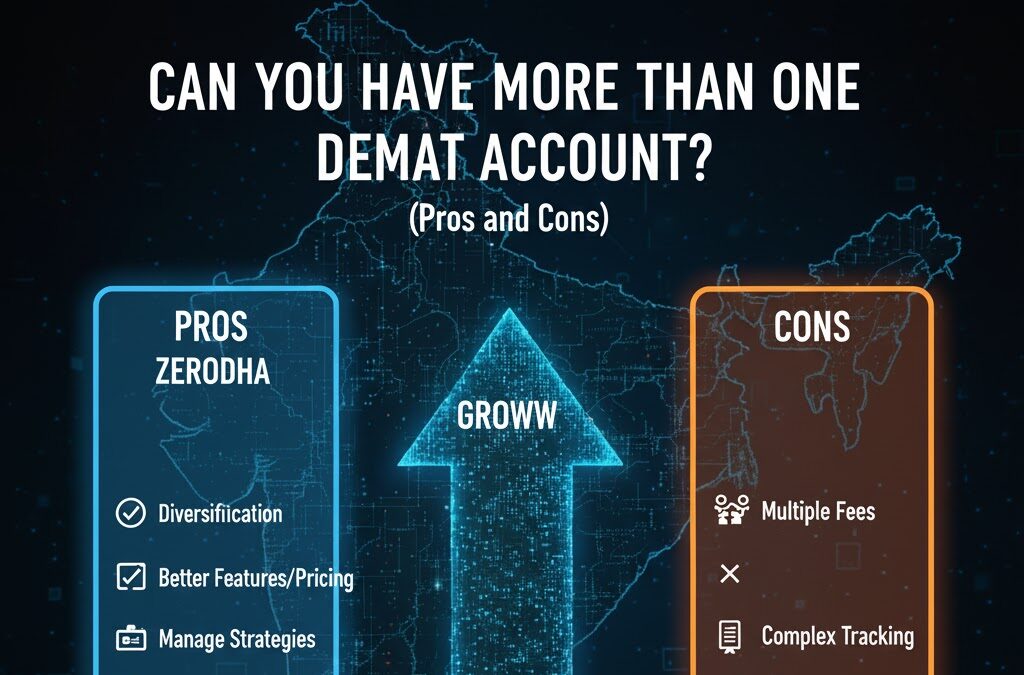
This is one of the most common questions investors ask as they become more experienced: Are you allowed to have more than one Demat account?
The short answer is yes, absolutely.
An individual can open multiple Demat and Trading accounts in their name, and it is perfectly legal. However, there is one simple rule:
You can open multiple Demat accounts with different brokers (Depository Participants), but you cannot open more than one Demat account with the same broker.
For example, you can have one Demat account with Zerodha, one with Groww, and one with HDFC Securities, all linked to your single PAN card. But you cannot have two separate Demat accounts with Zerodha.
Your PAN Card is the single unique identifier that links all your financial accounts. While you can have many Demat accounts, they will all be mapped to your one PAN.
But why would anyone want the hassle of multiple accounts? As it turns out, there are several strategic advantages, as well as some clear disadvantages. Let’s explore the pros and cons.
✅ The Pros: Why You Should Consider Multiple Demat Accounts
Opening a second or third Demat account is often a smart move for experienced investors and active traders.
1. Separate Your Investing from Your Trading This is the single biggest advantage. It’s a powerful psychological and organizational strategy.
- Account 1 (The “Vault”): Use this for your long-term investments. This is your “Buy and Hold” portfolio with stocks you believe in for 5, 10, or 20 years. You rarely touch this account.
- Account 2 (The “Playground”): Use this for all your short-term trading, swing trading, or F&O trading. This separation prevents you from accidentally selling your long-term “blue-chip” shares when you’re making a quick intraday trade. It also gives you a much clearer picture of your performance for each strategy.
2. Have a Backup Broker The stock market is driven by technology, and technology can fail. On high-volatility days (like the budget day or an election results day), it’s not uncommon for a broker’s app to freeze, crash, or face login issues due to massive traffic. If your only broker is down, you are stuck and could face huge losses. Active traders always keep a second account with a different broker as a backup to exit their positions or place a critical trade.
3. Test New Platforms and Features Are you curious about Zerodha’s “Kite” platform but currently use Groww? You can open a Zerodha account to test its features, speed, and user interface without closing your existing account. If you like it better, you can gradually move your capital.
4. Access to Different Research & Products
- Discount Brokers (e.g., Zerodha, Groww): These are fantastic for low-cost, high-speed execution. But they provide almost no research or stock tips.
- Full-Service Brokers (e.g., ICICI Direct, HDFC Sec): These brokers have high-quality, in-depth research reports, market analysis, and stock recommendations. An investor might keep a full-service account to get access to this research and a discount broker account to actually place the trades at a lower cost.
5. Access to Specific Products Not all brokers offer all products. One broker might have a seamless interface for investing in US Stocks (like Angel One or Groww), while another might have a superior platform for Commodity or Currency trading. Having multiple accounts lets you use the “best in class” broker for each specific product.
❌ The Cons: The Downsides of Multiple Demat Accounts
Before you rush to open a second account, you must be aware of the disadvantages.
1. The Biggest Con: Annual Maintenance Charges (AMC) This is the most significant drawback. Almost every broker (except a few) charges an Annual Maintenance Charge (AMC), which can range from ₹200 to ₹800+ per year. If you have three Demat accounts, you will be paying AMC on all three of them. This is a direct, guaranteed “loss” from your pocket every year, whether you use the accounts or not.
- Pro Tip: If you open a secondary account, strongly consider a broker that offers Lifetime Zero AMC (like Groww or Paytm Money) to avoid this cost.
2. Complexity and Hassle More accounts mean more to manage. You will have:
- Multiple login IDs and passwords.
- Multiple apps on your phone.
- Different platform interfaces to get used to.
- Funds spread across different broker wallets. It can become confusing to get a single, clear picture of your total net worth.
3. Complications in Tax Filing This is a major administrative headache. At the end of the financial year, you must download the Capital Gains Statement, Profit & Loss Statement, and other tax documents from every single broker you have an account with. You or your chartered accountant will then need to manually consolidate all this data to file your Income Tax Return. This is tedious and increases the chance of errors.
4. Risk of “Dormant” Accounts If you don’t use one of your Demat accounts for a long period (typically 12-24 months), the broker will classify it as “Dormant” or “Inactive.” To reactivate it, you will have to go through the entire re-KYC (Know Your Customer) process again, which involves submitting your documents and verification.
⚠️ The Great IPO Myth: BUSTED
There is a very common myth that if you have 5 Demat accounts, you can apply for an IPO 5 times to increase your chances of allotment.
This is 100% FALSE. In fact, it will get all your applications REJECTED.
The stock exchange uses your PAN number as the unique identifier for an IPO application, not your Demat account number. You are only allowed one application per PAN for an IPO.
If you apply from your Zerodha account and also from your Groww account (both linked to your one PAN), the system will detect both applications as duplicates, and both will be disqualified. Do not make this mistake.
Final Verdict: Should YOU Have More Than One Demat Account?
The answer depends on your profile as an investor.
- For 90% of Beginners and Passive Investors: No. It is completely unnecessary. The added cost (AMC) and complexity are not worth it. Your focus should be on learning and investing consistently. Stick to one good, low-cost Demat account.
- For Active Traders (Intraday, F&O): Yes, it is highly recommended. Having a backup broker is a professional trading practice. The cost of a second AMC is tiny compared to the potential loss from a platform crash.
- For Experienced Long-Term Investors: Yes, it is a very good strategy. Separating your core “long-term” portfolio from your “satellite” (experimental or short-term) portfolio in two different accounts is one of the smartest organizational moves you can make.
Final Tip: If you decide to open a second account, make it a Zero AMC account. This gives you all the “Pros” (like a backup broker or a separate portfolio) without any of the “Cons” (the annual cost).