Welcome to the world of stock market investing! As you start your journey, you will immediately encounter two terms: “Demat Account” and “Trading Account.” For most beginners, these two phrases are confusing. Are they the same thing? Do you need one, or both?
The most common point of confusion is that when you sign up with a modern broker like Groww, Zerodha, or Angel One, you fill out one application and get one app. This makes it seem like you’re opening a single account.
In reality, you are opening two distinct and separate accounts that are bundled together for your convenience.
Understanding the difference between a Demat account and a Trading account is the most fundamental step to understanding how the stock market actually works.
Let’s use a simple analogy right from the start:
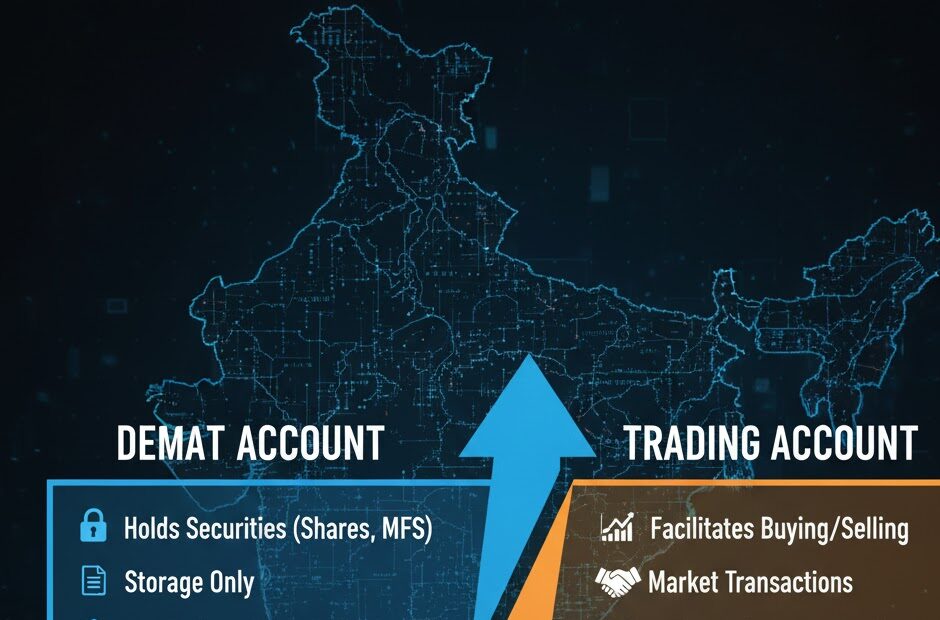
- A Demat Account is like your digital locker or bank safe (e.g., a vault). Its only job is to hold your shares and other securities safely.
- A Trading Account is like your gateway to the marketplace (e.g., the stock exchange). Its only job is to place buy and sell orders.
You need both. You use the Trading Account to buy shares, and once bought, they are delivered to and stored in your Demat Account (your locker). When you want to sell, you use the Trading Account to place the sell order, which then takes the shares from your Demat locker to sell them on the market.
Let’s dive deeper into each one.
Section 1: What is a Demat Account? (Your Digital Vault)
Demat is short for Dematerialization.
Before the 1990s, when you bought shares, you were given a physical paper “Share Certificate.” This was risky (they could be lost, stolen, or forged) and inefficient (selling them took weeks).
A Demat account solves this problem. It is an account that holds all your financial securities—like stocks, bonds, mutual funds, and Exchange Traded Funds (ETFs)—in a digital, or “dematerialized,” format.
Key Pointers on Demat Accounts:
- Its Only Purpose is Storage: A Demat account cannot place an order. It cannot buy or sell. Its job is purely to store. It is a record-keeping system.
- Like a Bank Account for Shares: Think of your bank account. It holds your money (e.g., ₹50,000). It shows “credits” (when money comes in) and “debits” (when money goes out). A Demat account is exactly the same, but it holds securities. It shows “credits” (e.g., +10 shares of Reliance) and “debits” (e.g., -10 shares of Reliance).
- Who Manages It? (The “Backend”): This is a crucial point. Your Demat account is not actually held by your broker (like Zerodha or Groww). Your broker is just a Depository Participant (DP)—an agent.Your account is officially held by one of India’s two central depositories:
- NSDL (National Securities Depository Limited)
- CDSL (Central Depository Services Limited)
These two large, secure institutions are the official “keepers” of all shares in India. Your broker (the DP) simply gives you access to your NSDL/CDSL account. This is why, even if your broker were to shut down, your shares are 100% safe with NSDL or CDSL.
Section 2: What is a Trading Account? (Your Gateway to the Market)
If the Demat account is the locker, the Trading account is the key, the marketplace, and the transaction counter all in one.
A Trading account is what you actually use to participate in the stock market. It is the account that is linked to the stock exchanges (NSE – National Stock Exchange and BSE – Bombay Stock Exchange).
Key Pointers on Trading Accounts:
- Its Only Purpose is Transaction: The Trading account is where all the action happens. You log into your Trading account (i.e., your broker’s app like Kite, Groww, or Angel One) to:
- Add or withdraw money.
- View live stock prices.
- Place a “BUY” order.
- Place a “SELL” order.
- The Crucial “Bridge”: The Trading account is the bridge that connects your Bank Account (for money) and your Demat Account (for shares). It can’t exist on its own; it must be linked to both.
- Who Manages It?: Your Trading account is opened with and managed by a SEBI-registered stockbroker (like Zerodha, Angel One, HDFC Securities, etc.). The app or website you use is the interface for your trading account.
You cannot buy a stock directly with a Demat account, and you cannot store a stock in a Trading account. They are two separate steps in a single process.
Section 3: How They Work Together: A Step-by-Step Example
This is the most important part for a beginner. Let’s walk through a complete transaction.
Scenario 1: You Decide to BUY 10 Shares of Tata Motors
- Step 1 (Bank to Trading): You transfer ₹10,000 from your Bank Account (e.g., HDFC Bank) to your Trading Account (e.g., your Groww wallet). Your Trading account balance is now ₹10,000.
- Step 2 (Trading Account): You log into your Trading account app, search for Tata Motors, and place a “BUY” order for 10 shares.
- Step 3 (Stock Exchange): Your Trading account sends this order to the stock exchange (NSE/BSE). The exchange finds a seller, and the trade is executed.
- Step 4 (Trading to Bank): The cost of the shares (e.g., 10 shares @ ₹1000/share = ₹10,000) is immediately debited from your Trading Account funds. Your Trading account balance is now ₹0.
- Step 5 (Demat Account): The next business day (known as T+1 Settlement), 10 shares of Tata Motors are credited to your Demat Account.
Result: Your Demat account now holds 10 shares of Tata Motors. Your Trading account is ready for the next trade.
Scenario 2: You Decide to SELL those 10 Shares of Tata Motors
- Step 1 (Trading Account): You log into your Trading Account app and place a “SELL” order for your 10 shares of Tata Motors.
- Step 2 (Demat Account): Your broker will ask for authorization (usually via a TPIN from CDSL/NSDL). This is you giving permission to “unlock” your Demat locker.
- Step 3 (Demat to Exchange): Once authorized, 10 shares of Tata Motors are debited from your Demat Account and sent to the exchange.
- Step 4 (Stock Exchange): The exchange finds a buyer, and the trade is executed.
- Step 5 (Trading Account): The next business day (T+1 Settlement), the sale proceeds (e.g., 10 shares @ ₹1050/share = ₹10,500) are credited to your Trading Account funds.
- Step 6 (Trading to Bank): You can now withdraw this ₹10,500 from your Trading Account back to your Bank Account.
Section 4: Comparison Table: Demat vs. Trading Account
| Feature | Demat Account (The Locker) | Trading Account (The Marketplace) |
| Primary Purpose | To hold (store) your securities in electronic format. | To execute (buy and sell) your orders on the stock exchange. |
| Analogy | A digital locker, vault, or a bank account for shares. | A marketplace, a trading terminal, or your “buy/sell” button. |
| What it Holds | Securities: Shares, Bonds, Mutual Funds, ETFs, SGBs. | Cash: The money (trading balance) you add from your bank. |
| Managed By | A Depository Participant (DP) on behalf of NSDL/CDSL. | A SEBI-registered Stockbroker (e.g., Zerodha, Angel One). |
| Primary Function | “Credit” (receiving) and “Debit” (releasing) of securities. | Placing orders, managing funds, viewing market data. |
Section 5: The Big Question: Can You Have One Without the Other?
This is where the technical details become interesting.
Case 1: Can you have ONLY a Demat Account (No Trading Account)?
Yes. It is technically possible. You would do this if:
- You are applying for an IPO: You can apply for an IPO using your bank account (ASBA) and just provide your Demat account number. If shares are allotted, they are credited directly to your Demat.
- Receiving Shares: If someone is gifting or transferring shares to you, or you are inheriting them, you only need a Demat account to receive them.
- Converting Physical Shares: If you have old physical share certificates, you only need a Demat account to convert them into digital form.
The Limitation: In all these cases, you hold the shares, but you cannot sell them. To sell them on the stock exchange, you must have a Trading Account.
Case 2: Can you have ONLY a Trading Account (No Demat Account)?
Yes. This is also possible, but only for specific types of advanced trading.
- Use Case: Trading in the Equity Derivatives segment (i.e., Futures & Options – F&O) or the Currency and Commodity derivatives segments.
- Why? These are financial contracts that are settled in cash. You are not buying or selling any actual shares that need to be held or stored. Since there is no “delivery” of shares, there is no need for a Demat (storage) account.
- Important: For a regular investor who wants to invest in stocks (buy and hold), this does not apply.
Conclusion for 99% of Investors: To buy and sell stocks in India, you must have both a Demat Account and a Trading Account.
Final Verdict: The 2-in-1 Account
The reason this might have been confusing is that virtually every modern broker in India offers a “2-in-1 Account.” When you complete their online application, they open both a Trading Account (with them) and a Demat Account (with NSDL/CDSL) for you simultaneously. They are linked together from day one.
When you use your broker’s app, you are using the Trading Account interface, which, behind the scenes, is fully connected to your Demat locker.
- Demat Account = Your secure storage.
- Trading Account = Your action-taking platform.
Understanding this “backend” process—how your money, your orders, and your shares move between your Bank, Trading, and Demat accounts—makes you a more knowledgeable and confident investor.